Sexual Abuse Victims
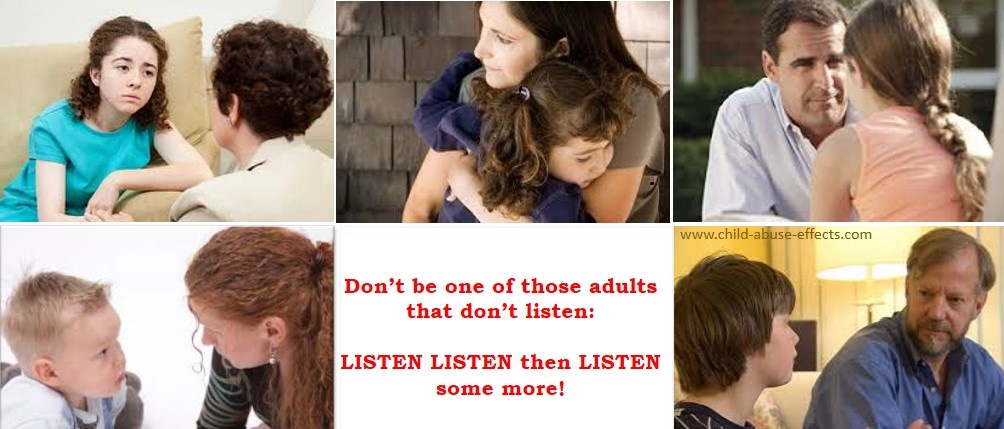
Sexual abuse victims live in a state of fear. Not just for themselves. They identify with their abusers and fear for them, in part because most are well known to the child or youth. They fear the repercussions for the family, especially when it's a family member doing the abusing.
|
3 basic types of victims: Each of the 3 suffer with their own unique forms of victimization and resulting challenges: The #1 reason victims don't tell is they are afraid they won't be believed. The longer the secret continues, the more trapped in the abuse the child or youth becomes. |
|
How Victims Adapt to the Abuse:
 |
sexual abuse victims minimize the abuse by pretending that whatever is happening is not really bad--this can take the form of a tough sense of humour |
|
|
they rationalize the abuse by explaining it away--they blame the abuse on the offender's drinking, drug use, etc.; they develop a twisted sense of love, telling themselves the offender is showing them love |
|
|
they deny that the abuse ever took place |
 |
When children's self reports of sexual abuse were compared to video tapes of the incident on film apprehended from the perpetrator, it was found that child victims have a tendency to deny or belittle the experience (Sjoberg & Lindbland, 2002, pp.312-3141). |
|
|
victims forget that the abuse ever took place, which is one of the most common and effective ways children deal with abuse |
|
|
they label themselves--victims believe they deserve the abuse and that it's their fault. Nothing can be further from the truth! |
|
|
they become controlling--victims try to control themselves and others; they become super-alert and eager to please |
Though
these coping skills are self-destruction, they are highly effective:
they help numb the pain and get the child or youth through each day.
Why Children Don't Tell
Sexual abuse is shrouded in secrecy. Child and adolescent sexual abuse victims are encouraged to keep the abuse secret because:
|
|
Children fear reprisals from the offender. |
|
|
Offenders tell the child that no one will believe them; and that even if someone does believe, the child will be blamed for the abuse. |
|
|
Offenders openly threaten the safety of the child and/or members of the child's family. |
|
|
Offenders tell the child the perpetrator will get into trouble if
anyone discloses the sexual abuse. This is particularly fearsome for the
child when the perpetrator is a family member, because the child fears
abandonment. |
|
|
Offenders promise gifts and rewards and offer bribes for the child to
keep the secret. With young children, this can be candy, toys, trips to
McDonald's. With youth, it can be videos, DVDs, rides in a car, sports
tickets, sports equipment, clothes, makeup, jewellery, money, anything
that is valued by the youth. |
Some Statistics for Sexual Abuse Victims:
|
|
85% of runaways in Toronto are sexual abuse victims (Conference on Child Victimization & Child Offending, 20002). |
|
|
Adolescents with a history of sexual abuse are significantly more likely than their counterparts to engage in sexual behaviour that puts them at risk for HIV (Brown et al., 2000, pp. 1413-14153). |
|
|
A study which inspected the strength of different risk factors for childhood sexual abuse among 179 pre-adolescent girls found that maternal sexual abuse history combined with maternal drug use placed daughters at the most elevated risk. Girls whose mothers were sexual abuse victims were 3.6 times more likely to be victimized (McClosky & Bailey, 2000, pp. 1019-10364). |
|
|
The incidence of child sexual abuse was 1.8 times higher among children with disability compared to the incidence among children without disability. The most common disabilities noted included emotional disturbance, learning disability, physical health problems, and speech or language delay or impairment (Barnett et al., 1997, p. 495). |
|
|
Child sexual abuse victims are ten times more likely to attempt suicide (Conference on Child Victimization & Child Offending, 20006). |
|
|
Child sexual abuse victims are seven times more likely to become drug/alcohol dependent (Conference on Child Victimization & Child Offending, 20007). |
Similarities Between Male and Female Victims:
Based on a study of 401 child sexual abuse cases: |
||
|---|---|---|
| Sexual Abuse | Male | Female |
| ¤ threatened with physical harm | 51% | 37% |
| ¤ physical force used | 48% | 50% |
| ¤ under 12 years old | 81% | 70% |
| ¤ under 6 years old | 32% | 18% |
| ¤ abused over time | 43% | 47% |
| ¤ multiple offenders | 20% | 13% |
| ¤ residing with offender | 21% | 42% |
| ¤ abused by parent or parent surrogate | 8% | 31% |
| ¤ abused by juveniles | 56% | 28% |
| ||
<< back
References
NOTE: Information pages on this site were based on material from the
Sexual Abuse Victims
1 Sjoberg, R., & Lindbland, F. (2002). Limited disclosure of sexual abuse in children whose experiences were documented by videotape. American Journal of Psychiatry, 15(9), 312-314.
2 Conference on Child Victimization & Child Offending. (2000). Working together for children: Protection and prevention data needs for timely intervention.. Paper presented in Toronto, Ontario.
3 Brown, L. et al. (2000). No title. In Sexual Abuse Statistics (Impact of Child Sexual Abuse). Retrieved November, 2002, from http://www.prevent-abuse-now.com/stats.htm#child
4 McClosky, L., & Bailey, J. (2000, October). The intergenerational transmission of risk for child sexual abuse. Journal of Interpersonal Violence, 14(10), 1019-1036.
5 Barnett, O., Miller, P., & Perrin, R. (1997). Family violence across the life span.. Thousand Oaks, California, SAGE Publications, Inc.
6 & 7 Conference on Child Victimization & Child Offending. (2000). Working together for children: Protection and prevention data needs for timely intervention.. Paper presented in Toronto, Ontario.
8 Becker, J. (1988). The effects of child sexual abuse on adolescent sexual offenders. In E. Wyatt and G. Powell (Eds.), Lasting Effects of Child Sexual Abuse.. Beverly Hills, CA: SAGE Publications, Inc.
 Canadian Red Cross RespectED Training Program. Written permission was obtained to use their copyrighted material on this site.




From Victim to Victory
a memoir
How I got over the devastating effects of child abuse and moved on with my life
From Victim to Victory
a memoir
How I got over the devastating effects of child abuse and moved on with my life
Most Recent

-
Converging Stolen Lives
Jan 30, 18 01:13 PM
There was a time and space I didn’t think about you, or your abuse. Where when I looked back at my life, I only saw normal things, a normal childhood. -
A letter to one of the 13 Turpin children
Jan 29, 18 11:33 AM
A heartfelt letter by a former classmate that speaks to bullying and regrets. You'll find it on my Facebook group. I hope you'll join and get in on the discussion. -
Dissociated From Abuse
Jan 29, 18 11:00 AM
I was sexually abused by my father from age 6 to 13, which stopped when I started talking about it during the day. The teenage brother of my best friend