Physical Child Abuse Effects
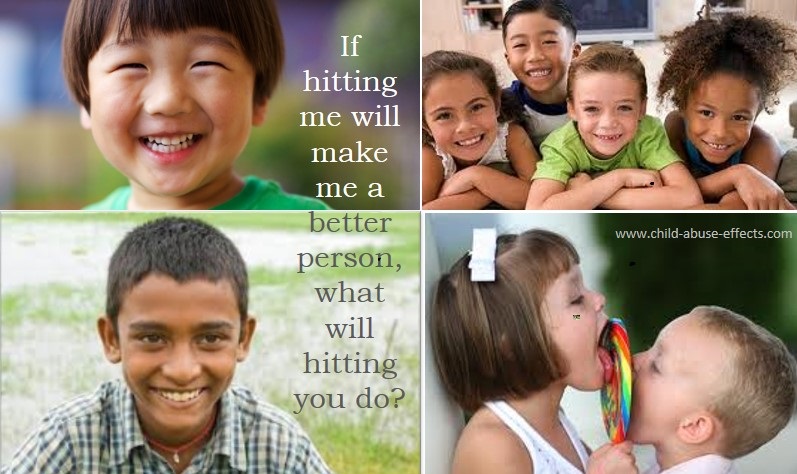
Physical child abuse effects vary from child to child, depending on these multiple factors:
» Severity of physical abuse
» Frequency of physical abuse
» Age of the child when physical abuse began
» Child's relationship to the abuser
» Availability of support persons
» Child's ability to cope
» Severity of Physical Abuse:
How hard a child is struck is only one aspect of severity. The implement the child is struck with is also a factor. This does not mean that using an open hand or fist will result in fewer or lesser effects. The harm done to the child is measured both by physical injury and emotional injury. |
|
» Frequency of Physical Abuse:
A single incident of physical abuse can result in severe trauma, but generally, the more often the physical abuse occurs the greater the impact on the child.
» Age of the child when physical abuse began:
The younger the child was at the onset of physical abuse, the greater the imprint, and thus, the greater the impact. This is particularly evident when the abuse continues throughout the child's life.
» Child's relationship to the abuser:
When a child has a very close relationship with his/her abuser, the feelings of betrayal are that much greater; the very person who is supposed to protect is instead hurting that child.
» Availability of support persons:
When a child has no one to turn to, increased feelings of abandonment occur, which in turn adds to the physical child abuse effects.
» Child's ability to cope:
A child will find a way to cope with the abuse. The methods a child uses can add to the effects. Coping skills can be:
 |
Physical, such as raging or becoming the "comedian" or "class clown". While being "funny" is generally considered an attribute, there are children who use humour to cover up the fact that they are suffering. |
|
|
Emotional, such as the child refusing to try anything new for fear of failure, and therefore avoids receiving even more negative messages about themselves. |
|
|
Inward, where the child turns against him/herself, either physically (such as in self-harming in the form of cutting or burning) or emotionally (such as in self-blame). |
|
|
Outward, such as when the child acts out against someone else. |
Overall Physical Child Abuse Effects:
Children and youth suffer physical pain, trauma, and emotional scars when they are victims of child abuse. The physical child abuse effects also vary depending on the age of the child.
Child
» does not trust
» fearful of physical contact
» startles easily, cowers, cringes
» afraid when other children cry
» aggressiveness or withdrawn
» exaggerated politeness
» profound sadness
» difficulties in school
» difficulty concentrating
» lying
» stealing
» low self-worth
» psychosomatic illnesses
Youth
» does not trust
» developmental lags
» never cries or always cries
» extreme aggression or extreme passivity
» thrill-seeking behaviours
» manipulative
» self-harm and/or harms others
» failing in school, truancy
» sets up negative reactions from others
» inability to control emotions; physically lashes out
» short attention span
» substance abuse
» runaway
» criminal behaviours
» suicide ideation
» attempted or completed suicide
Societal Price in Physical Child Abuse Effects
Older children become increasingly involved in a variety of self-destructive behaviours:
 |
Physically abused adolescents are likely to engage in many high risk health behaviours: carry weapons, fight physically, consider suicide, smoke cigarettes or marijuana, use alcohol or drugs, have three or more sexual partners (Nelson, Higginson & Grant-Worley, 1995, p. 12561). |
|
|
According to a study done by Newman & Newson (1990)2 on physical child abuse effects, the highest predictors of involvement in crime and delinquency are: being hit once per week or more at 11 years of age and having a mother, at that age, with strong beliefs in and a commitment to, corporal punishment. |
These self-destructive behaviours can lead to:
|
|
the death of the adolescent and/or others |
|
|
increased likelihood of incarceration in adulthood |
|
|
increased medical costs for psychological problems, as well as the physical effects of long-term substance abuses |
|
|
decreased productivity in the work force as these adult victims of physical child abuse attempt to cope with their pasts |
|
|
future generations of physical child abuse victims requiring medical and psychological attention as the cycle of abuse is perpetuated |
More physical child abuse pages on this site:
| Physical Child Abuse | Abuse & Discipline | Physical Abuse Statistics |
References
NOTE: Information pages on this site were based on material from the  Canadian Red Cross RespectED Training Program. Written permission was obtained to use their copyrighted material on this site.
Physical Abuse Effects
1 Nelson, D., Higginson, G., & Grant-Worley, J. (1995, November). Physical abuse among high school students. Arch Pediatric Adolescent Medicine, 149, 1254-1259.
2 Newman, J. & Newson, E. (1990). The extent of physical punishment in the U.K. London: Approach.


From Victim to Victory
a memoir
How I got over the devastating effects of child abuse and moved on with my life
From Victim to Victory
a memoir
How I got over the devastating effects of child abuse and moved on with my life
Most Recent

-
Converging Stolen Lives
Jan 30, 18 01:13 PM
There was a time and space I didn’t think about you, or your abuse. Where when I looked back at my life, I only saw normal things, a normal childhood. -
A letter to one of the 13 Turpin children
Jan 29, 18 11:33 AM
A heartfelt letter by a former classmate that speaks to bullying and regrets. You'll find it on my Facebook group. I hope you'll join and get in on the discussion. -
Dissociated From Abuse
Jan 29, 18 11:00 AM
I was sexually abused by my father from age 6 to 13, which stopped when I started talking about it during the day. The teenage brother of my best friend