Internet Sex Offenders
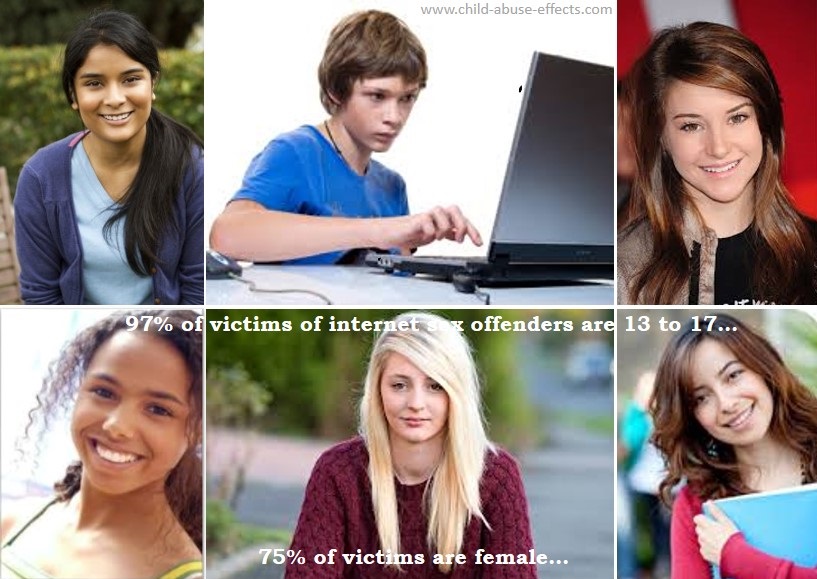
Internet sex offenders typically start exploiting in a very non-threatening way, "luring" children and youth to reveal personal details about themselves and family members. Internet offenders are definitely on the rise.
|
Most internet-initiated sex crimes are non-forcible crimes committed by men who are much older than their victims.
It is inaccurate to characterize Internet offenders as "strangers" because in most cases they have communicated extensively with victims, both online and offline before ever meeting face-to-face. Offenders often give gifts to victims, like jewellery, teddy bears, clothing, smartphones, digital cameras, anything that young people would enjoy having. |
|
Statistics for Internet Sex Offenders
 | A random national sample of 2574 law enforcement agencies found the following results concerning sexual offenses against juvenile victims that originated with online encounters (Wolak et al., 20041; Internet-initiated Sex Crimes against Minors: Implications for Prevention Based on Findings from a National Study 2004): |
» 79% include telephone conversations
» 48% send pictures online to victims
» 47% send or offer gifts or money
|
| A U.S. study surveying a nationally representative sample of 1,501 children/youth aged 10-17 who regularly use the Internet found the following results regarding sexual solicitations and exposure to sexual materials (Finkelhor et al., 20002; Crimes Against Children Research Centre, 2002): |
- 19% of the children/youth surveyed reported being approached for sex through Internet media at least once a year; 1 in 7 of these children reported that the Internet sex offenders also attempted to contact them by telephone or by mail
- 24% of all solicitations and 34% of all aggressive solicitations were made by adults aged 18 and older.
- 25% of all aggressive solicitations were made by females
- Chat Rooms were the medium for two-thirds of the solicitations, and 24% came through Instant Messaging
Internet Guidelines for Parents
Though there are several international agencies working toward protecting children and youth from Internet sex offenders, it is ultimately the responsibility of the parents to protect their children. Some guidelines for parents:
 |
Learn how the Internet works and what the dangers are. |
|
|
Keep the computer in the family room, not-the-more-private child's bedroom. |
|
|
Discuss safety issues with your child and use filtering software if necessary. |
|
|
Ensure that children never reveal personal and private information about themselves or family members. |
|
|
Never let children meet an online new friend without accompanying them. |
|
|
Know where and to whom you can report any questionable or suspicious activity. |
<< Back to Sex Offenders
References
NOTE: Information pages on this site were based on material from the  Canadian Red Cross RespectED Training Program. Written permission was obtained to use their copyrighted material on this site.
Internet Sex Offenders
1 Wolak, J., Finkelhor, D., Mitchell, K. (2004) Internet-initiated Sex Crimes against Minors: Implications for Prevention Based on Findings from a National Study. Funded by the National Center for Missing & Exploited Children and by the U.S. Department of Justice, Office of Juvenile and Delinquency Prevention.
2 Finkelhor, D., Mitchell, K., & Wolak, J. (2000, June). Online victimization: A report on the nation's youth. Alexandria, VA.: National Center for Missing and Exploited Children.




From Victim to Victory
a memoir
How I got over the devastating effects of child abuse and moved on with my life
From Victim to Victory
a memoir
How I got over the devastating effects of child abuse and moved on with my life
Most Recent

-
Converging Stolen Lives
Jan 30, 18 01:13 PM
There was a time and space I didn’t think about you, or your abuse. Where when I looked back at my life, I only saw normal things, a normal childhood. -
A letter to one of the 13 Turpin children
Jan 29, 18 11:33 AM
A heartfelt letter by a former classmate that speaks to bullying and regrets. You'll find it on my Facebook group. I hope you'll join and get in on the discussion. -
Dissociated From Abuse
Jan 29, 18 11:00 AM
I was sexually abused by my father from age 6 to 13, which stopped when I started talking about it during the day. The teenage brother of my best friend